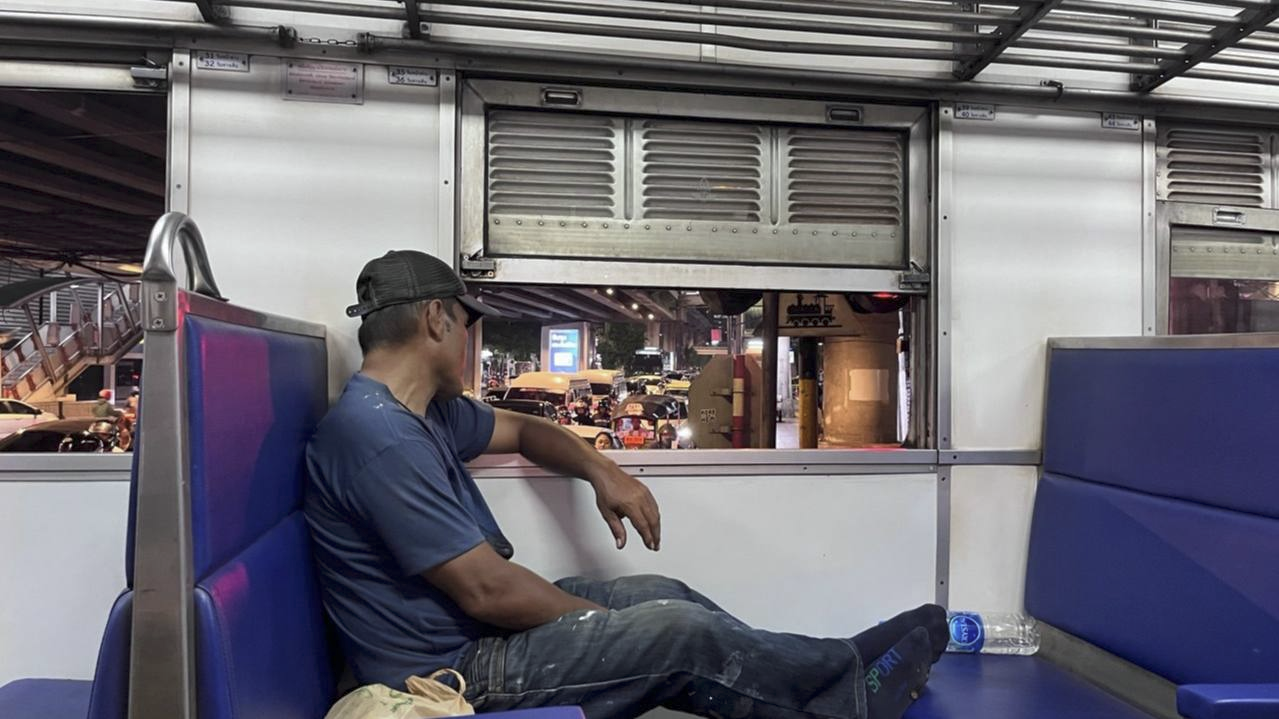
On 15 May 2026, a heavy freight train collided with a bus and several other vehicles at a level crossing in Bangkok, killing eight and injuring over 30.
To understand how the accident happened, we first need to know the surroundings of the area. The accident happened near the SRT Asok halt, at the level crossing that separates the stations westbound and eastbound platforms.
Not to be confused with the BTS Asok Station down the road, the crossing is part of a larger junction of the SRT Eastern Line, Asok Montri Road (to Ratchadaphisek Road), Kamphang Phet Road 7 Road and by extension, Phetchaburi Road.
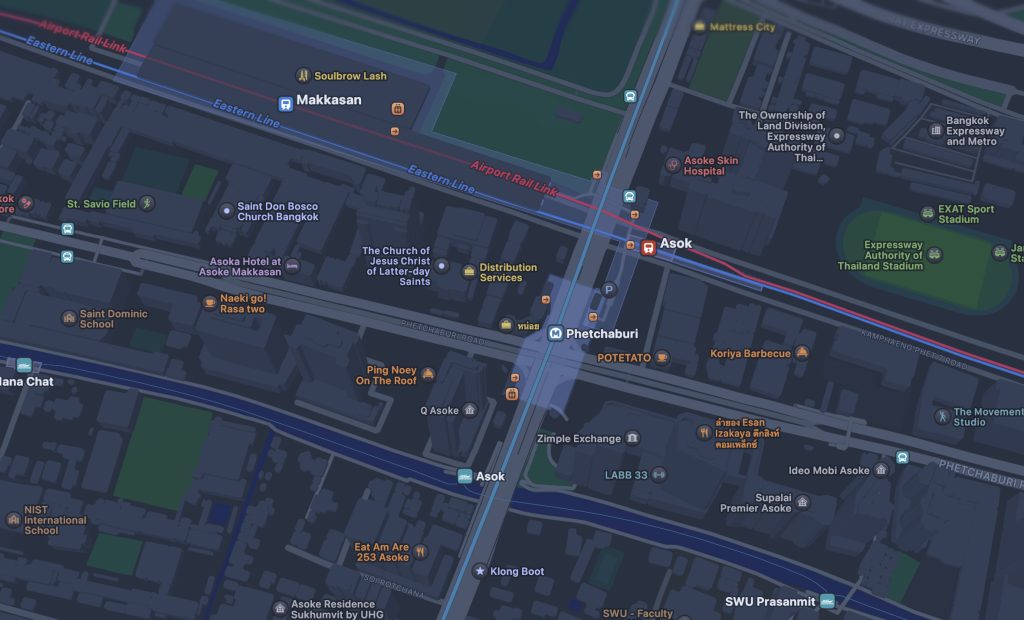
Around the area is the lively central and business area of Asoke, with notable landmarks around such as the GMM Building, Srinakharinwirot University and the Singha Complex Building. Most of these landmarks run down Asok Montri Road, one of the most major and crowded roads in the city. Built for a capacity of 35,000 vehicles, over 100,000 use the road daily.
The area is also an important interchange for the Airport Rail Link to the MRT Blue Line and the Khlong Saen Saep Canal Boat. An overhead linkway connects the Airport Rail Link and MRT Blue Line, well utilised by the many tourists staying around Sukhumvit MRT station.
It might seem odd that a railway line cuts right through this area, but the eastern line, where the railway is on, has existed for 120 years with very little alignment change, while the city around it grew rapidly.
While the area around is bustling, modern and generally has great facilities, the same can’t be said about the SRT rail facilities in the area. Its latest upgrade was the addition of a tin roof to its two tiny platforms.
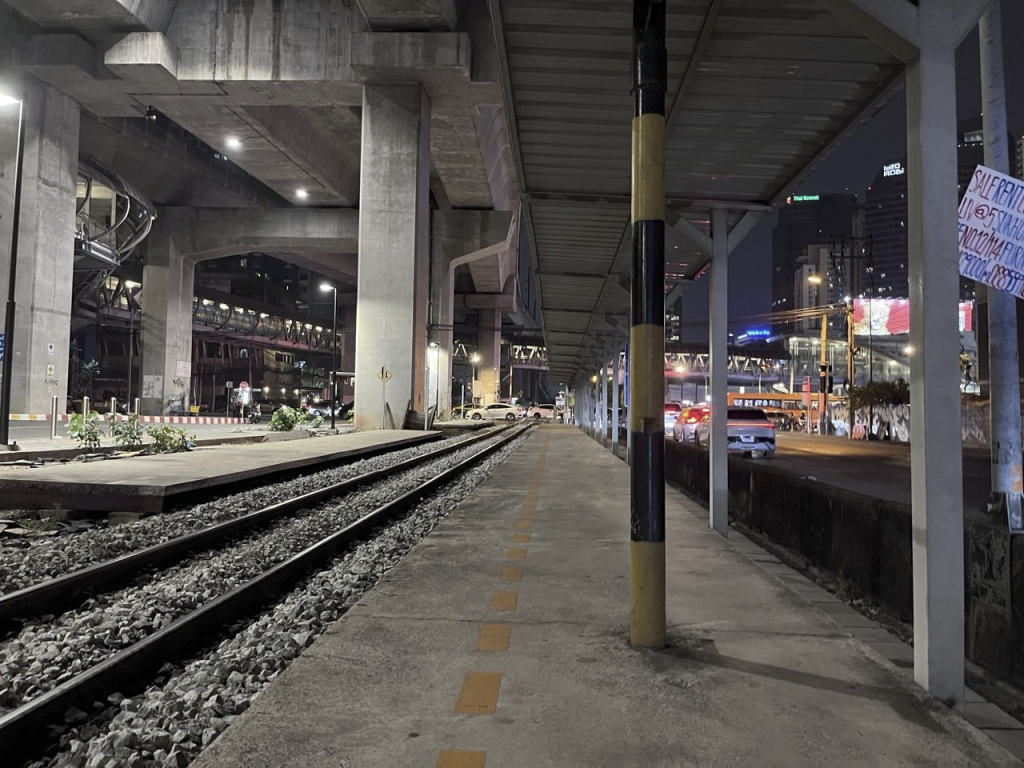
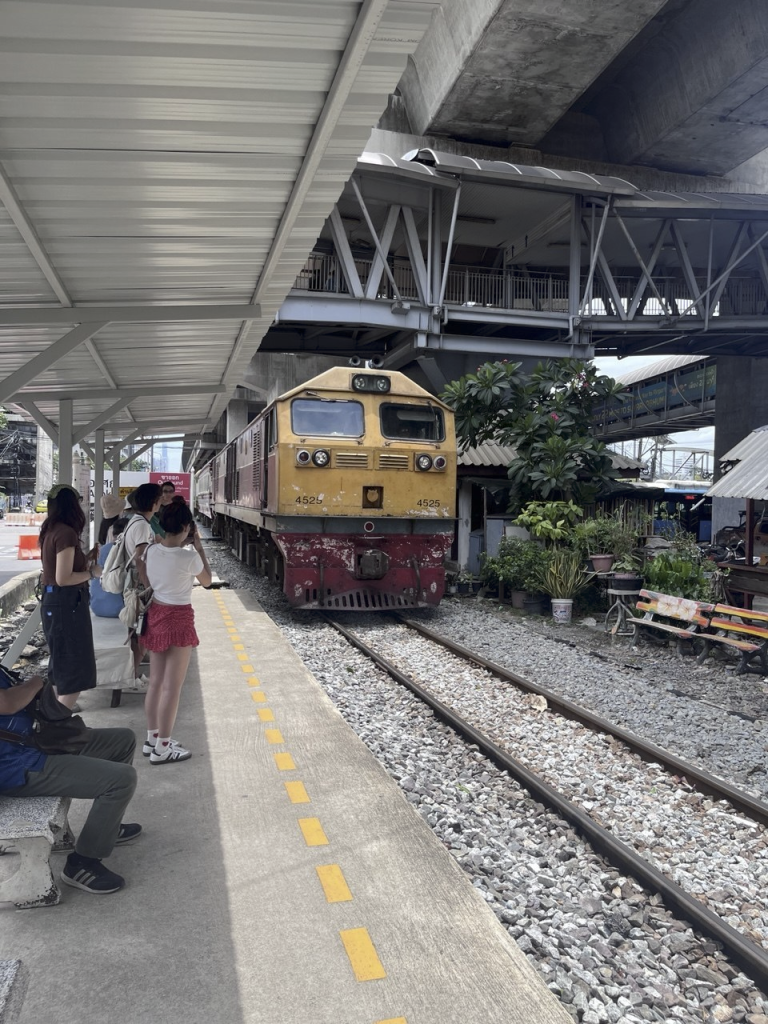
An afternoon commuter train bound for Chacheongsao at the westbound platform in August 2025.
Passenger facilities are basic at best, and there are no facilities to buy tickets on the platform.
The station’s prime location has attracted many commuters working in the area coming in from the suburbs and satellite cities in the east like Hua Mak, Chacheongsao and Lat Krabang. In addition, SRT provides fares that could be as much as 15x cheaper (2THB vs 30THB) than the Airport Rail Link that follows the same alignment.
Even if you overlook the dire financial situation of the railway, due to its prime location, there is little space for the station to improve and expand its facilities. On a regular day, one train per hour will come through this junction. A regular rail crossing usually looks like this:
Steam train in the heart of bangkok
by u/enewssg in trains
Add an overcrowded road, impatient drivers, poor road design and a road crossing, and you get an accident waiting to happen.
The Incident
Just before 4:00pm local time, Freight train 2126 from Laem Chabang Port was travelling towards Bang Sue Junction when it crashed into bus 206 (3-30). The bus was thrown across the road, hitting other motorcycles and cars in the process, before erupting into flames.
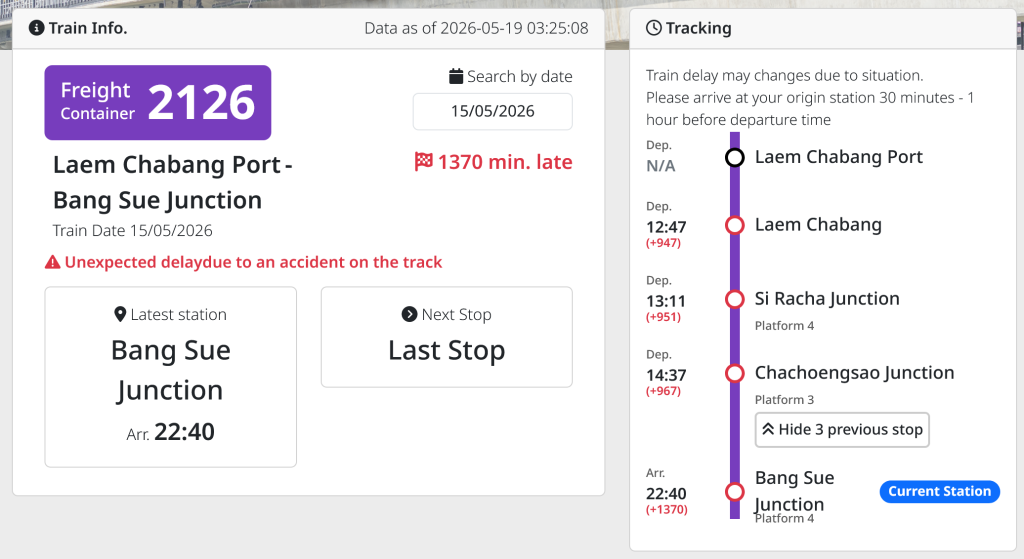
While we don’t know the exact cause, we have a rough timeline that we can build.
After passing the previous station Khlong Tan 2800 meters away, the train travelled at around 34 km/h, within the 40km/h speed limit of the area. Black box data shows the train only hit on the emergency brakes roughly 100 meters from the accident point.
A crossing status signal, that shows if a crossing lowered with flashing white lights, is also present at the end of the eastbound platform at Asok Halt. The last colour light signal before the accident site was around 500 meters before the accident site.
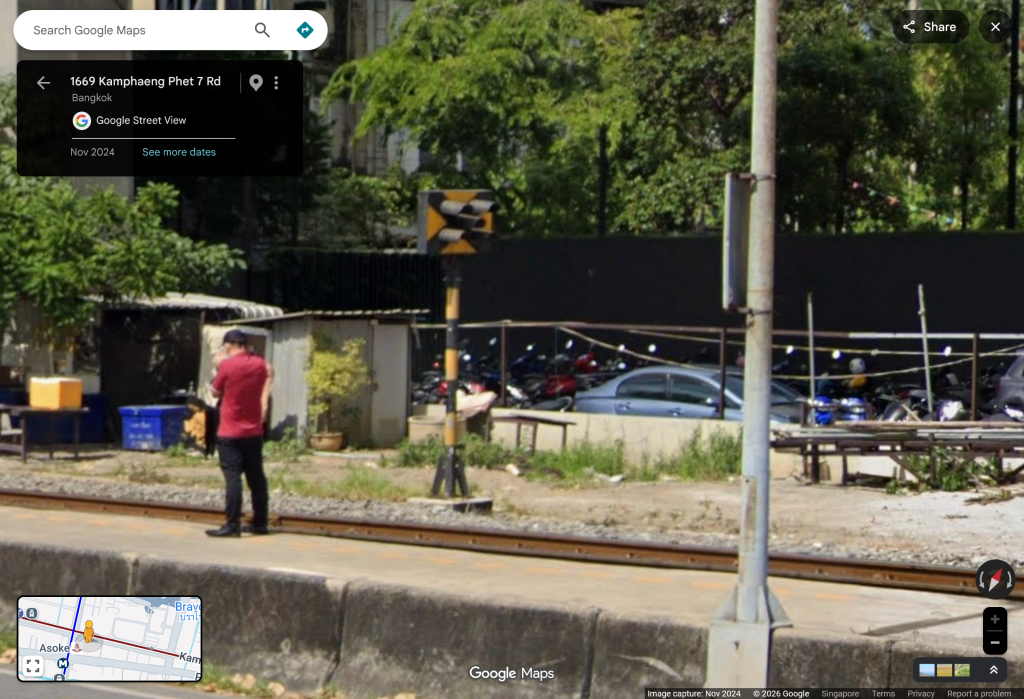
In Thailand, especially around central Bangkok where crossings are often clogged, the crossing operator can also show signals manually using red and green flags.
This means that in addition to the white flashing crossing signal, drivers will need to look out for the crossing operators hand signals. CCTV footage showed the crossing operator give a red flag, a hand signal that the train was to not proceed as the crossing was unclear. According to the Acting Director of the SRT, drivers typically see signals from 300 to 500 meters away.
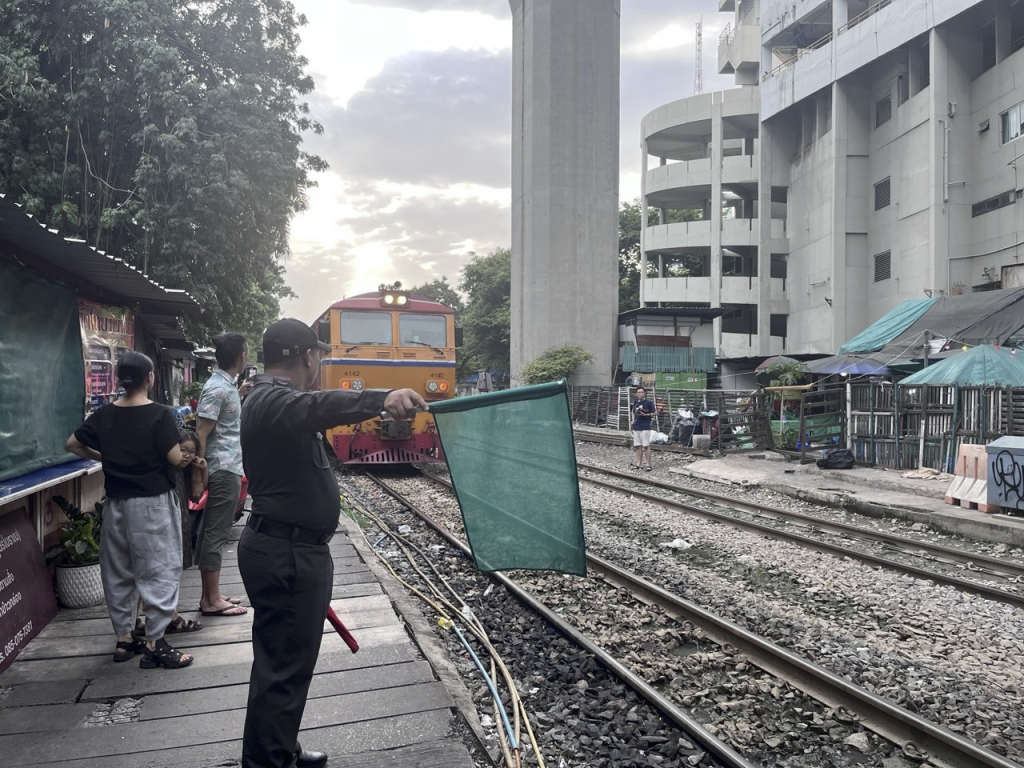
Eyewitness accounts mentioned the crossing guard did correctly sound the alarm to inform motorists that a train will soon be crossing. However, due to the stuck traffic on the crossing, he could not close the gates.
Many motorists incorrectly expected the train to slow down and waits till the road is clear. While this is usually the case, trains officially have the right of way, and have a much longer braking distance than cars.
This section of the SRT Eastern Line handles mainly commuter traffic, and trains are usually slowing down before this crossing to allow commuters to alight at Asok halt. This allows the train driver to easily stop at the crossing as they would already be slowing down to stop at the station.
However, there are still 4 express trains per week, empty coaching stock trains, and of course, freight trains, on the line.
The Director-General of the Department of Rail Transport previously made a statement that the train would have needed to apply the brakes 2000 meters before the stopping point to avoid an accident. However, this statement has been contested by multiple parties.
The State Railway Workers’ Union said for an accident to be avoided, the driver would need perform an emergency stop at only 200 meters before the site.
๑.กรณีที่อธิบดีกรมการขนส่งทางราง ให้สัมภาษณ์สื่อมวลชน ที่ขบวนรถต้องใส่ห้ามล้อก่อนถึงจุดที่หยุดระยะ 2 กิโลเมตร นั้น ไม่ถูกต้อง การจะหยุดขบวนรถได้อย่างมีประสิทธิภาพ จะประกอบด้วย ความสมบูรณ์ของรถจักร อัตราหน่วยลากจูงของขบวนรถ วันดังกล่าวขบวนรถมีหน่วยลากจูง ๕๗๘ หน่วย ความเร็วไม่เกินพิกัด ๔๐ กม./ชม. ระยะทางสามารถหยุดขบวนรถได้ตามปกติประมาณ ๒๐๐ เมตร ไม่ใช่ ๒ กิโลเมตร
State Railway Workers’ Union in their statement
The Director-General’s statement that the train would have needed to apply the brakes 2 kilometers before the stopping point was incorrect. Effective stopping distance depends on the condition of the locomotive, the hauling load of the train, and other operational factors. On the day of the incident, the train had a hauling load of 578 units and was traveling within the 40 km/h speed limit. Under normal conditions, the train could stop within about 200 meters , not 2 kilometers.
The Acting Director of the SRT mentioned in an interview that, including reaction time and the braking distance, it would only be 1,000 meters at a maximum speed of 120km/h. According to the director, at lower speeds, braking distance shortens proportionally to speed and train weight.
Using this with the average speed that the train was traveling, this gives us around 283 meters of braking distance. When you take away the reaction time of the driver, and the large load this train was carrying, this comes very close to the calculations of the State Railway Workers Union.
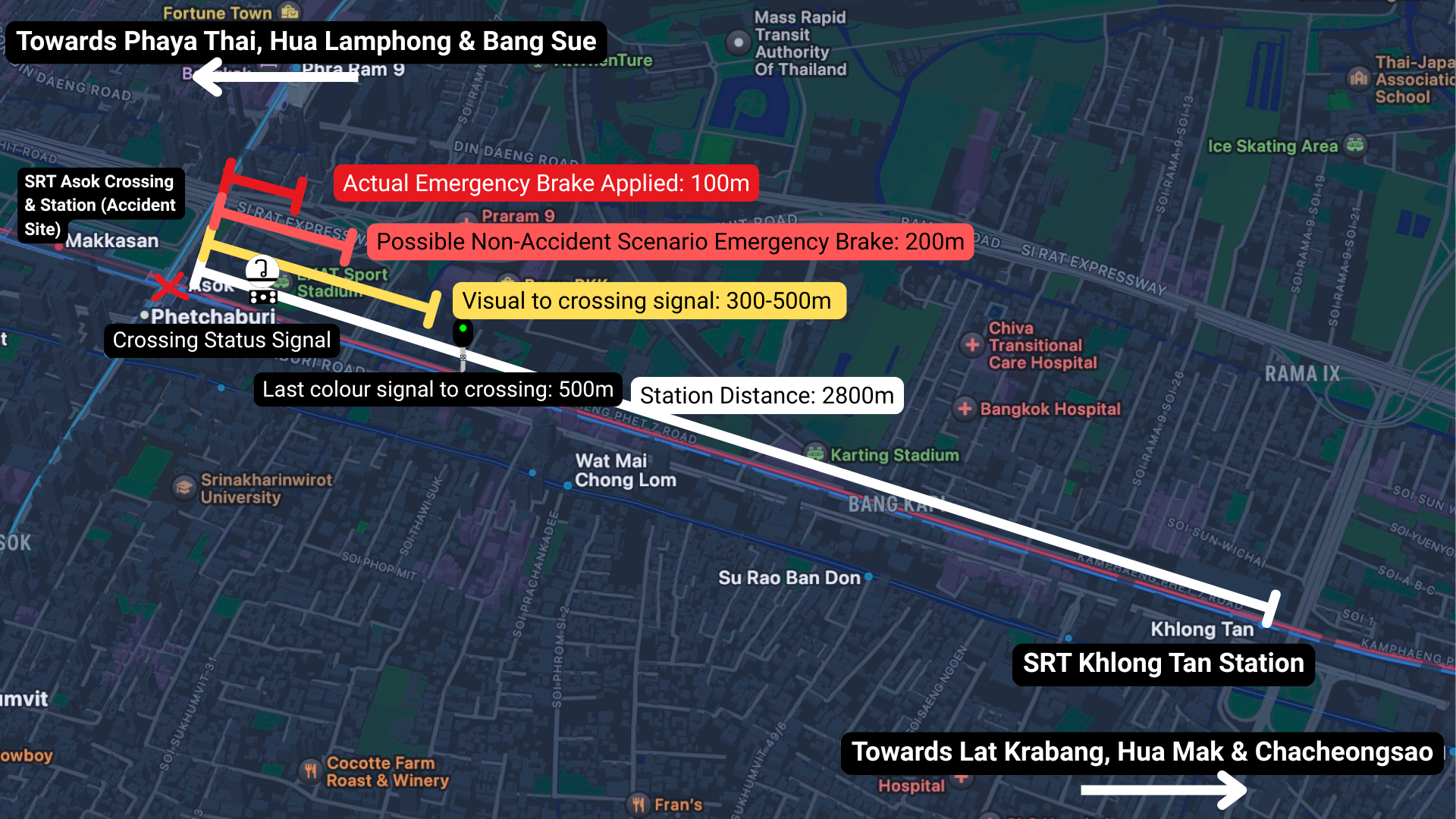
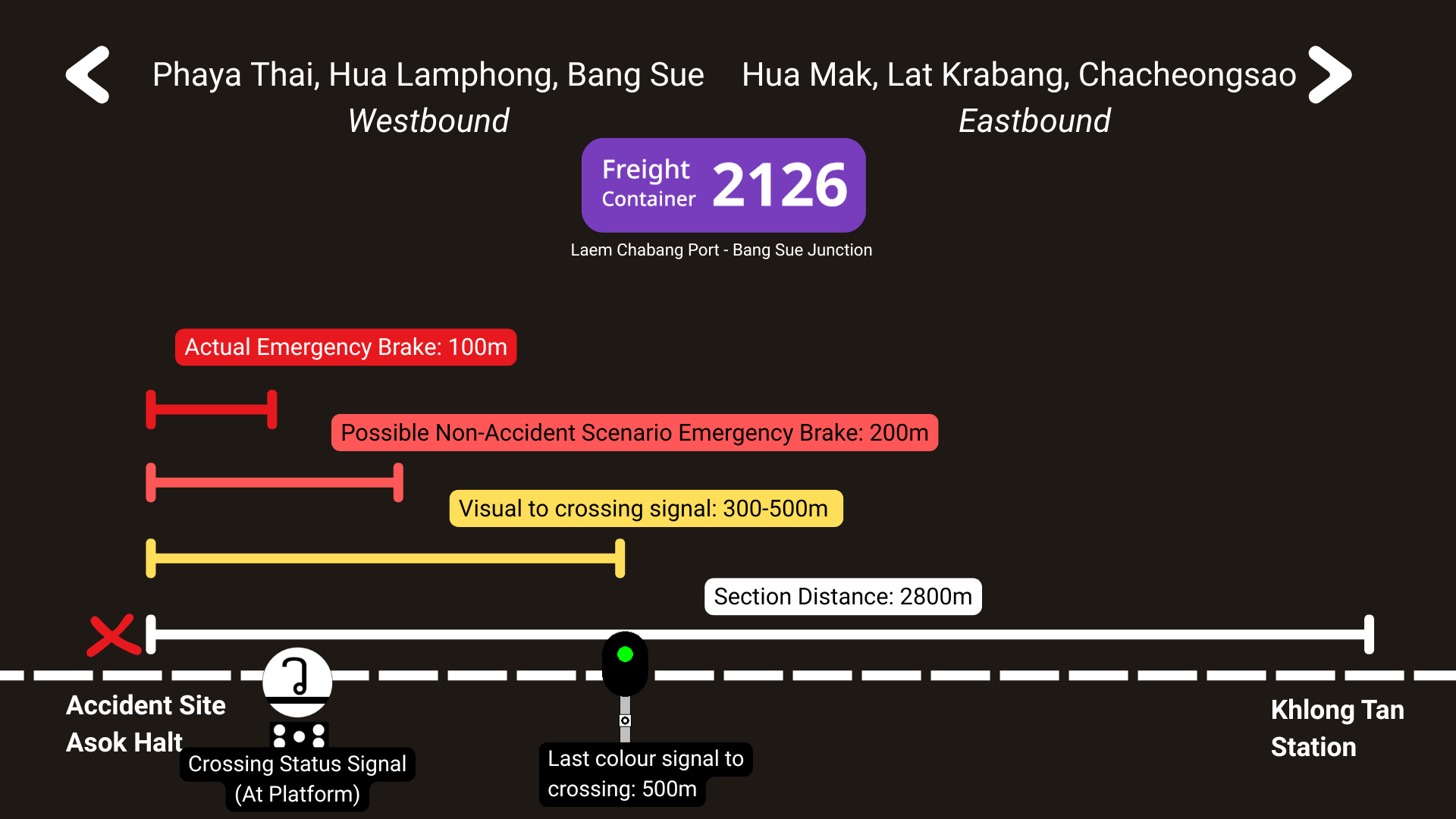
Distance markers and lines are estimates and not drawn to scale.
But even if the driver braked late, in an ideal world, the bus driver would have not been on the tracks, and the collision would have been avoided. So why was that the case?
The bus driver didn’t have a choice
On the day, while many angles of the video circulated, many unfamiliar with the area were asking the same question that I just posed — why was the driver stationary on the tracks despite the road markings and the obvious dangers?
The answer: he had no choice.
The bus driver had no choice but to stay on the tracks and disobey the road markings if he wanted a chance to continue at the upcoming junction. The poorly designed junction immediately after forces motorists to fight for lanes as the traffic of two roads merge at a 90 degree angle.
Despite there being a merging lane, road markings permit cars on lanes 2-4 to turn right, while lane 1 is blocked off by traffic barriers.
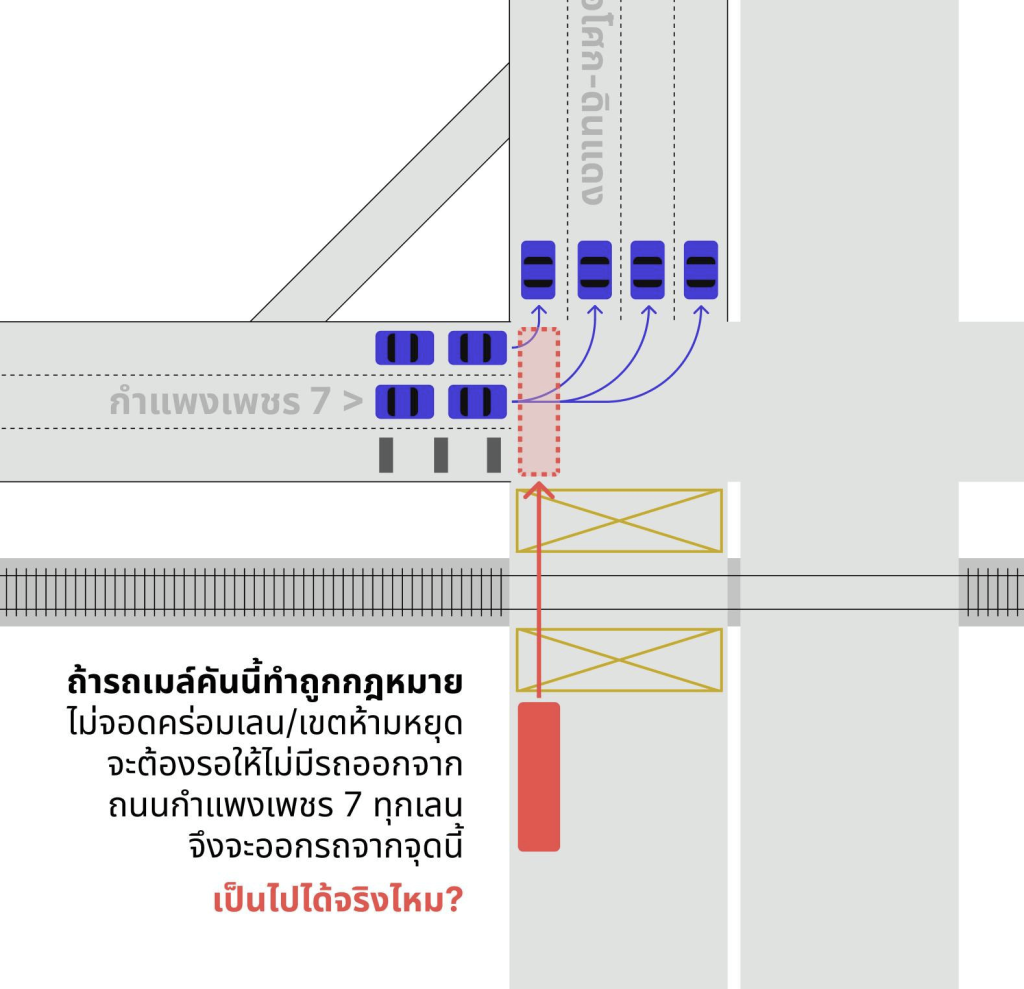
ถ้ารถเมล์คันนี้ทำถูกกฎหมาย
Thanawit Tae Prasongpongchai via infographic
ไม่จอดคร่อมเลน/เขตห้ามหยุด
จะต้องรอให้ไม่มีรถออกจาก
ถนนกำแพงเพชร 7 ทุกเลน
จึงจะออกรถจากจุดนี้
เป็นไปได้จริงไหม?
If this bus is operating legally by not stopping in no-stopping zones, they would have to wait until there are no more vehicles exiting from all lanes of Kamphaeng Phet 7 Road before moving. Is that really possible? (Translated)
Road markings viewable on Google Street view also show the same story that lanes 2-4 allow for right turns.
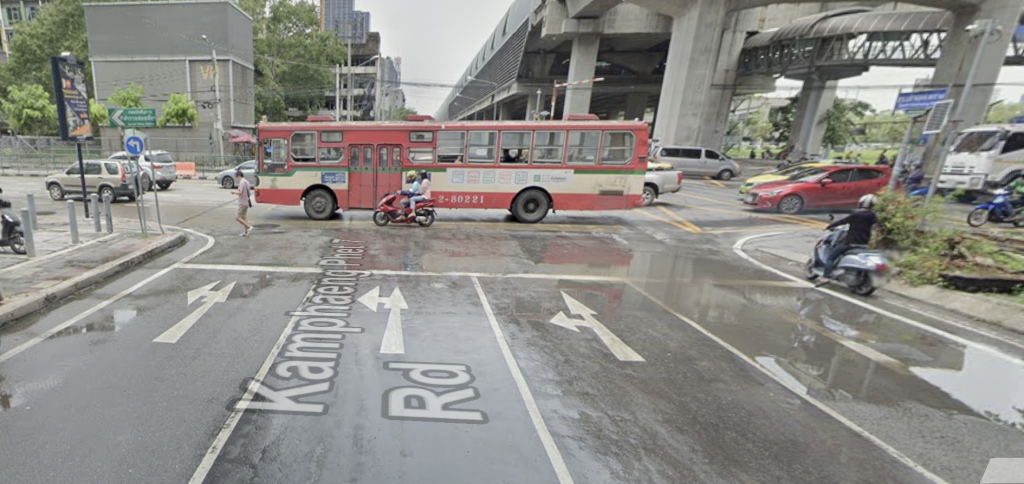
This is extremely poor road design on the planners to allow such filtering onto a busy road. Why even build a left filter lane if the road markings allow for turnings at the junction?
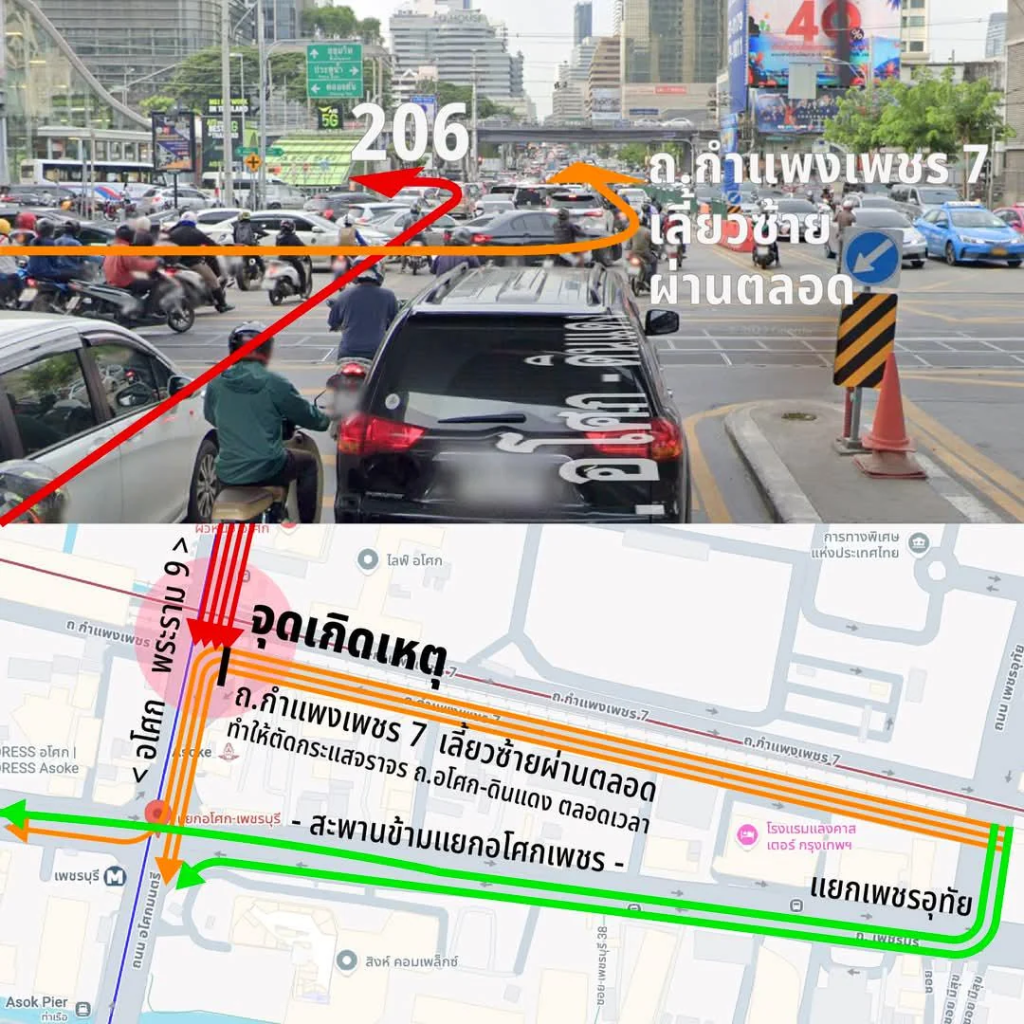
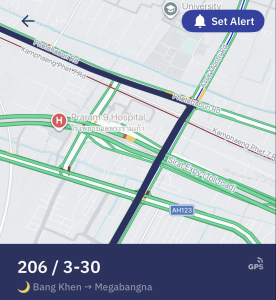
This junction forces cars coming down onto Asok Montri Road to ‘fight’ for space against cars from Kamphaeng Phet 7. So, in order to attempt to merge, the bus driver would have needed stop on the tracks.
This issue is further exacerbated when you observe route the bus driver has to take. The bus route, 206 (3-30) turns left at Phetchaburi Road, just 100m down the road from the level crossing. This means that the bus has to keep left, and fight with more lanes of traffic as opposed with staying on the right lane.
Incorrect accounts
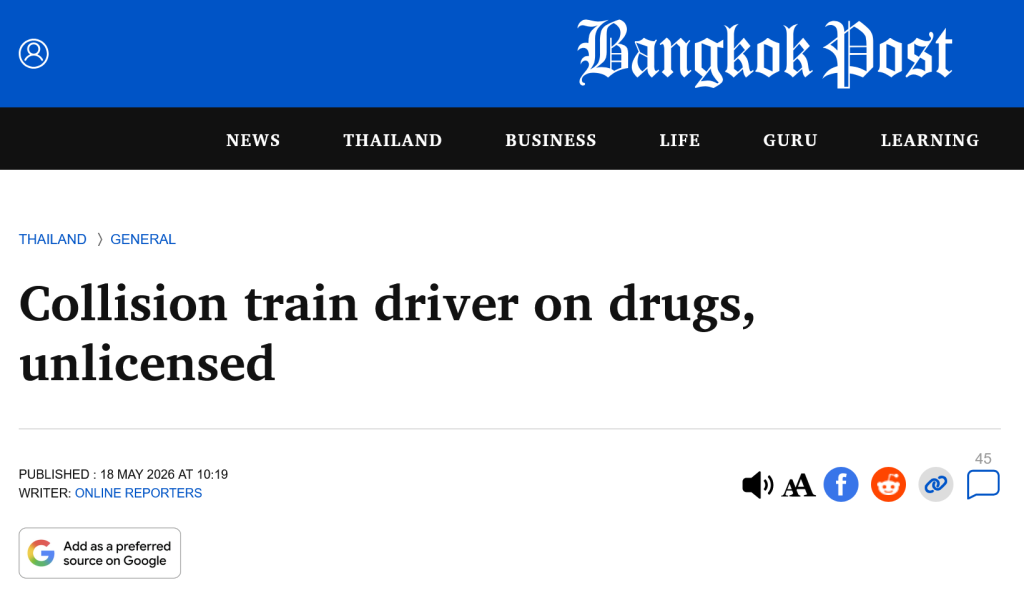
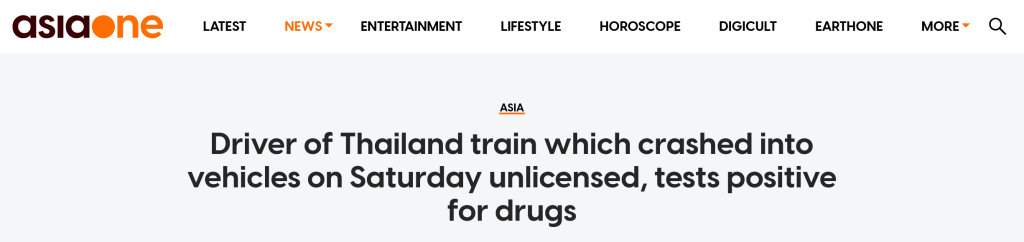
In addition to providing incorrect information on the stopping distance, A few days after the incident, reports came out publishing the Department of Rail’s initial findings into the incident noting that he was unlicensed. However, this report was false. The driver was not issued a license from the Department of Rail Transport, but the State Railway of Thailand (SRT), which is still valid to be used for operating trains.
Up until earlier this year, the state railway itself had previously issued its own licenses to its drivers for rail operation. For 130 years, the state railway itself was the issuing authority. The State Railway of Thailand Act of 1951 (B.E 2494) gave SRT the power to set rules, run services and license staff for their duties. SRT also owns its own vocational training school to train staff for roles like train operations, engineering and signalling.
According to the The State Railway Workers’ Union, this has also caused widespread misunderstanding, making the public believe that drivers were operating without licenses or legal qualifications. The misleading fact that the driver has already been circulated internationally and locally, with many news outlets failing to fact check their claims.
The new licensing scheme by the Department of Rail Transport was only introduced on 27 March 2026, when the Rail Transport Act (B.E 2568) in Thailand came into effect. Since this act allowed for the licensing of private rail operators in the country, a national licensing system had to be put in place.
Before the Rail Transport Act (B.E. 2568) came into force, all drivers had already gone through screening, training and testing. This is laid out in the State Railway of Thailand Regulation No. 3.1, issued under Section 25(3) of the State Railway of Thailand Act (B.E. 2494) according to the union.
SRT has already submitted its employee information to the department for processing of the new licenses. According to the The State Railway Workers’ Union, 951 license applications were submitted, and only 208 have been issued.
Legally, drivers are still allowed to use their SRT issued licenses during this transition period. According to railway staff, this period lasts for 120 days.
However, under the interpretation of the Department of Rail Transports initial findings, this would mean suspending the remaining 743 train drivers. In addition, there is still a train driver shortage in Thailand, with the union noting that 1,258 drivers are required to operate the network at its current capacity. These drivers must work almost continuously, with barely any rest, which could cause driver fatigue, another safety issue.
While it remains unclear whether the detected drug traces contributed to the accident, it is worth noting that SRT only conducts random drug tests during annual health checks and when taking on new employees. Alcohol and basic health checks are conducted more often, such as before duty, and the driver involved recently passed their latest test on 15 May 2026.
Random drug tests are generally standard around the world. In the UK, Network Rail conducts random tests for 20% of its workforce anually, up from 5% previously, according to the Rail, Maritime and Transport union in the UK.
Instead of choosing to investigate this incident, it appears that the government chose the driver as a scapegoat instead. While not innocent yet, setting the record straight that he was licensed is extremely important.
An example from Tokyo
Bangkok isn’t the first city to face this problem of freight and level crossings in its city.
In the early morning on 8th August 1967, a Japanese National Railways (JNR) freight train hauling limestone passed a red signal and collided with another freight train carrying jet fuel bound for an American military base collided with causing an explosion in Shinjuku, near where the current Seibu-Shinjuku Station stands.
72 metric tons of jet fuel were spilled, 1100 train services were affected and 2 million passengers were disrupted. This also drew attention to the fact that the Japanese were helping the Americans in their war in Vietnam, and sparked political riots.
During this time, Tokyo’s rail network was also becoming increasingly congested. After World War II, the population of the greater Tokyo region nearly doubled, with many people commuting in from places like Yokohama, Saitama and Chiba.
In 1965, to combat this and to add significantly more capacity to its lines, JNR drew up its Commuting Five Directions Operation (通勤五方面作戦). One of the methods to increase more passenger service was to convert many freight lines that ran through Tokyo for passenger service.
The Commuting Five Directions Operation also included plans to eliminate level crossings to reduce traffic congestion and for safety. At that time, there were about 1,400 grade crossings in the city, and large-scale grade separation projects were carried out by the local government. This involved elevating or lowering railways underground.
But where would all that freight traffic go? That is where the Musashino Line comes in. This line is a bypass loop line that loops around Northern Tokyo.
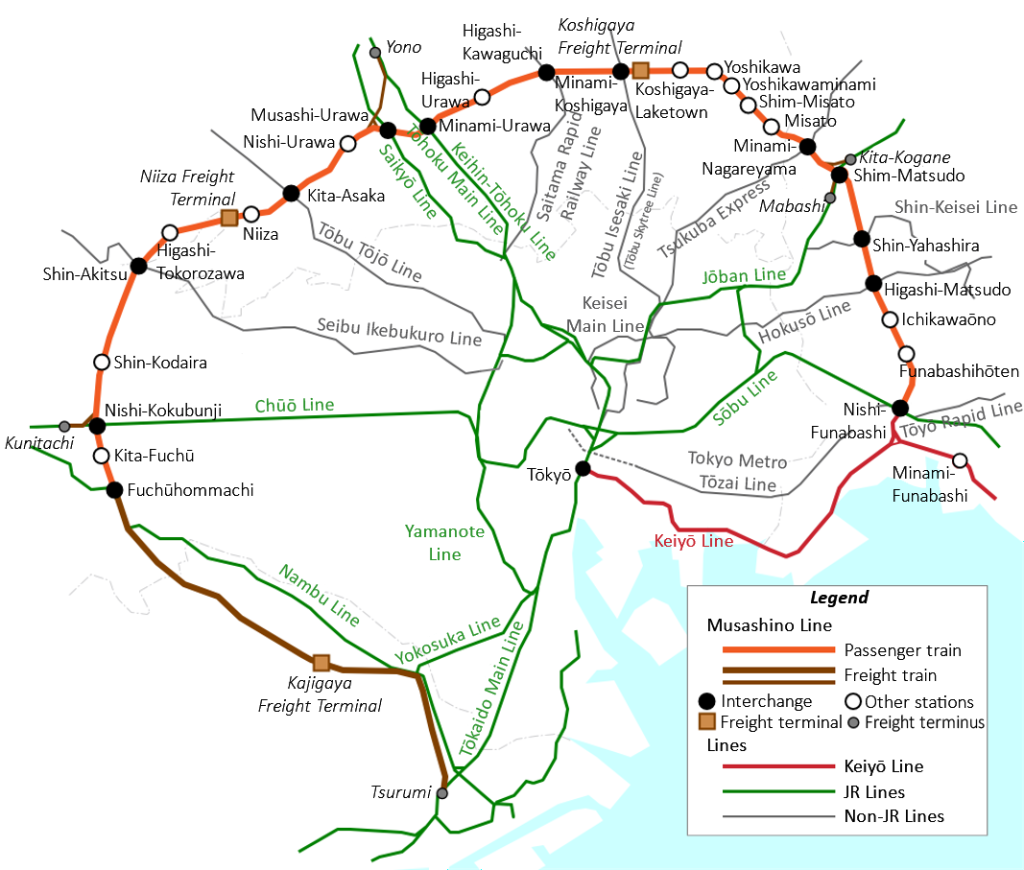
The Musashino Line was originally envisioned to be a freight only line that bypassed Tokyo city through Saitama Prefecture. Passenger service was also added too after protests from local residents upon the lines opening. Today, the Musashino Line is an essential commuter and freight line for JR East.
It provides through service to Tokyo station via the existing Keiyō Line, and more through rail service connections are also expected as JR partners with railway companies like Seibu.
This line solved the issue of running freight trains through the city centre, and also created more commuter options for those living in Saitama and Chiba.
Thailand itself already has a freight bypass line, running from Khlong 19 Junction in Chacheongsao to Kaeong Koi Junction in Saraburi. While this does route traffic away from Bangkok, many trains are still made to travel through the city.
Thailand could stand to benefit by doing something similar, by both reducing crossings and building a freight line.
If Bangkok were to have its Musashino Line counterpart, both commuters and SRT could stand to benefit. With a bypass line that is built to serve both passenger and freight services, better rail connections with Lat Krabang, Min Buri and Rangsit. Freight trains would no longer need to run within Bangkok, and should the line be elevated, running speeds can be increased.
However, the government appears to be taking a different approach. Instead, for long-term freight management, a third outer ring road will be developed so freight trucks can bypass the city.
Change, in the wrong direction
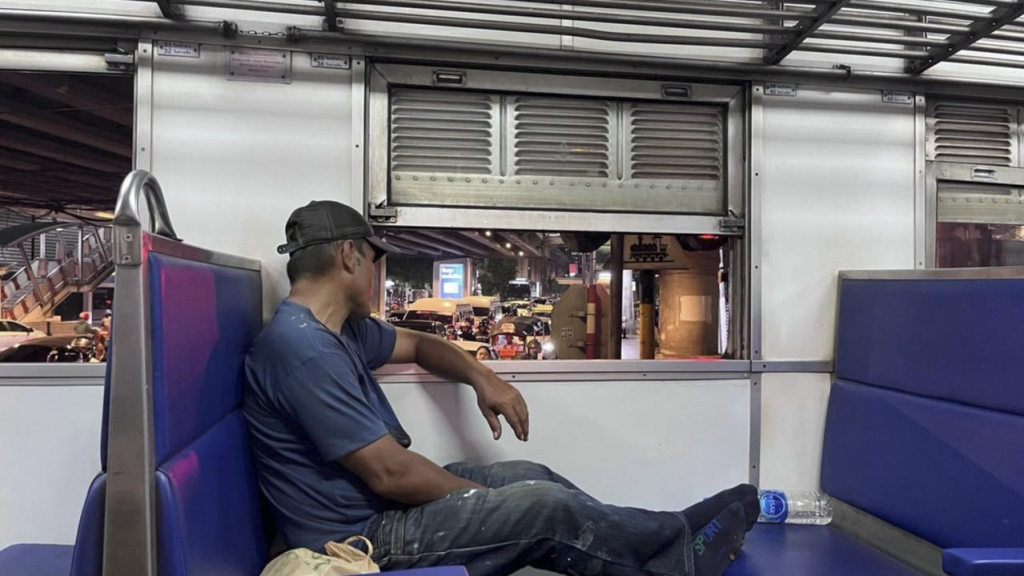
After the incident, the Ministry of Transport is pushing for change, but mostly in the wrong direction. Instead of addressing the road design issues that forced the driver of the ill fated bus to stay on the tracks, the train operations are going to be adjusted in the medium-term so that “long-distance and suburban trains do not enter inner Bangkok unnecessarily”.
This provides great inconvenience to users using the rail network. Users will now have to fork out extra time, extra transfers and more money with their plans. This makes train travel, which is already losing to road and air travel, even more unattractive for users.
News articles wrote that “western and southern line trains would stop at Taling Chan station, where passengers can connect to the Red Line.”
Reports referred to a ‘western line’, though no such line exists. Only the Suphan Buri and Kanchanaburi lines run from the west, connecting with the southern line at Nong Pla Duk Junction to head towards Bangkok.
For southern line passengers, this seemingly completely ignores the purpose built terminus at Krung Thep Aphiwat for these intercity trains. Krung Thep Aphiwat is the largest station in South-East Asia, and was built to handle this rail traffic. In addition, there is an elevated section of rail with no at grade crossings from Taling Chan to Krung Thep Aphiwat, the current terminus of these trains.
The same article mentions eastern line trains would terminate at Lat Krabang station, where passengers can connect to the Airport Rail Link. While the Airport Rail Link generally remains parallel to the eastern line, past Phaya Thai Station, passengers will then be left with no options in the medium term. Construction of the missing link from Phaya Thai to Krung Thep Aphiwat still has not started, but is noted to be ‘accelerated’ following this incident.
While the long term plans address the city’s needs better by looking towards elevation and the improvement of these rail services, these medium term plans are not well thought out. Authorities also have yet to address the poor road design that led to this accident.
Just yesterday, a man trespassed and was killed by a train when he climbed a barrier on Kamphaeng Phet Road, near the train-bus collision accident site.
In light of this incident, many have pledged for change. But until authorities set the facts straight, stop scapegoating and look at the systemic issues that caused this accident like the road design, these pledges will likely just turn into empty promises as more accidents happen.
Thank you for reading. If you found this insightful and like what you see, consider joining my Telegram Channel where i post updates on the blog and other cool stuff I am up to!


Leave a Reply